Skip to content
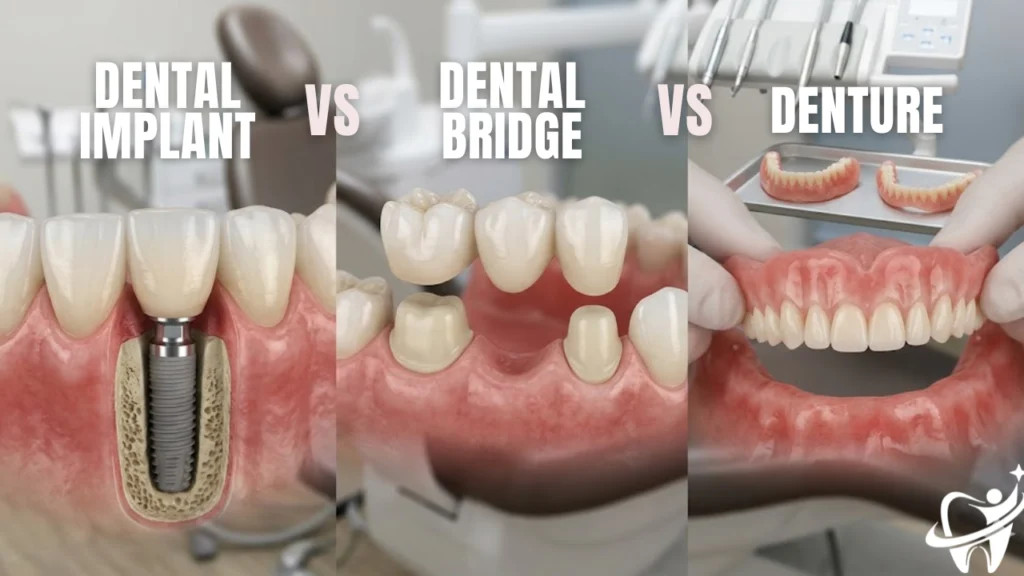
You had a tooth extracted, or maybe one fell out after years of trouble. Now you have a gap, and three options are sitting in front of you: an implant, a bridge, or a denture. Every option has its merits, and every option involves a trade-off. The right one for you depends on your bone health, your schedule, your budget, and how long you want the solution to last.
This guide explains each option plainly, compares them honestly, and gives you a clear way to think through the decision.

Why Does it Matter to Replace a Missing Tooth?
First of all, you must understand that a tooth does more than bite and chew. Its root stimulates the jawbone every time you eat, maintaining bone density in that area. When the tooth is gone, that stimulation stops. Within the first year after extraction, the bone in that area begins to shrink. This process is called resorption. Over several years, the bone loss can alter the shape of your face, cause neighbouring teeth to drift and tilt, and actually make future tooth replacement more complicated and expensive.
This is not meant to alarm anyone. It is simply the clinical reality that makes early treatment worth considering.
Another thing is how a gap between teeth affects your bite. When a tooth is missing, the teeth on either side and the opposing tooth in the other jaw lose their natural contact points. Over time, they can shift, tilt, or over-erupt into the space. This disrupts your bite and can lead to jaw strain, uneven wear on other teeth, and difficulty cleaning areas that have shifted out of alignment. If the missing tooth is visible, it can also affect confidence in professional and social settings.
Great Read: Root Canal Treatment in Nigeria
The Three Main Tooth Replacement Options
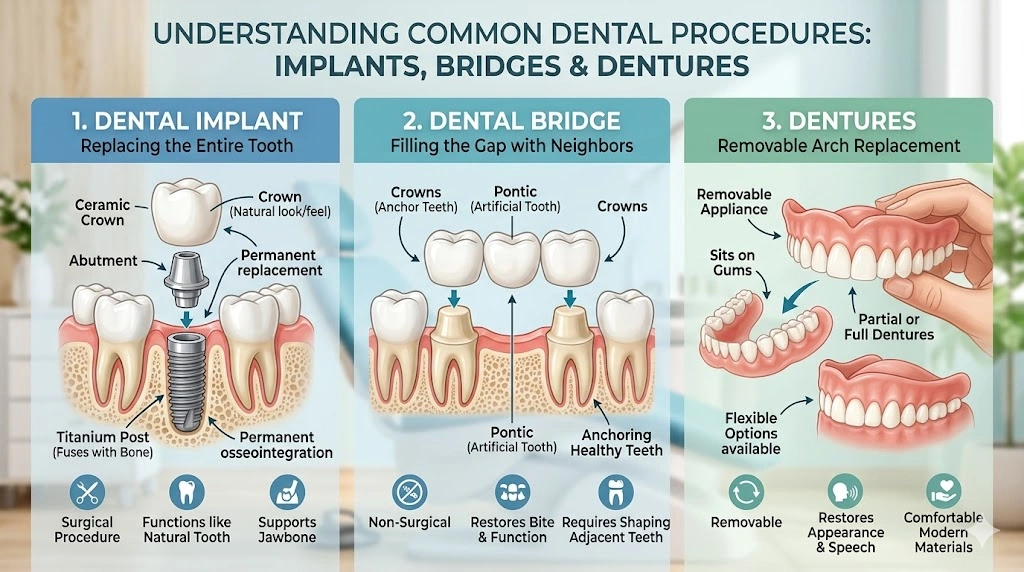
A dental implant replaces the entire tooth, root and all. A titanium post is surgically placed into the jawbone, which fuses with it over several months. A crown is then attached on top. It functions, looks, and feels like a natural tooth.
A dental bridge fills a gap by anchoring an artificial tooth, called a pontic, to the natural teeth on either side of the space. Those neighbouring teeth are shaped down and fitted with crowns that hold the bridge in place. No surgery is involved.
A denture is a removable appliance that sits on the gums. Partial dentures replace one or several missing teeth. Full dentures replace an entire arch. Modern dentures have come a long way in terms of fit and appearance, and flexible dentures in particular are significantly more comfortable than traditional acrylic ones.
Dental Implants: The Long-Term Solution
The implant process has two main phases. First, a titanium post, roughly the size of a tooth root, is surgically placed into the jawbone under local anaesthesia. Over the next three to six months, the bone grows around the post in a process called osseointegration. This is what gives the implant its stability. Once the post has fully integrated, a custom-made crown is attached to an abutment on top of the post. The result is a replacement tooth with its own artificial root.
Because the implant fuses with bone, it stimulates the jaw the same way a natural tooth does. This is the one option that actively prevents bone loss.
When it comes to dental implants, age is not a barrier. Adults of any age can receive implants provided the jaw has stopped growing. People who grind their teeth at night can still receive implants, but a night guard is usually recommended to protect the crown from excessive wear over time. You can read more about the advantages of dental implants.
How Long Implants Last
A 2024 meta-analysis published in Clinical Oral Investigations, which reviewed twenty years of survival data, found that implants maintain strong survival rates well into the second decade of use. Separate studies of large patient cohorts have reported survival rates of 98% or higher when implants are placed in healed sockets and maintained properly. With consistent oral hygiene and regular check-ups, an implant can genuinely last a lifetime — though the crown on top may eventually need replacing after fifteen to twenty years.
Cost of Dental Implants in Lagos
Based on current pricing at clinics in Lagos, a single dental implant typically starts from around ₦350,000 and can range up to ₦1.2 million or more. This price depends on the implant brand, whether a bone graft is required, the experience of the surgeon, and the clinic’s location and equipment level. All-on-Four and All-on-Six implant solutions for full arch replacement carry significantly higher costs. Check out our comprehensive post on the cost of dental implants to see the full picture.
Dental Bridges: A Reliable Fixed Option
A dental bridge literally bridges the gap left by a missing tooth. Two crowns are placed on the natural teeth on either side of the gap (these are called abutment teeth), and an artificial tooth, or pontic, is suspended between them. Everything is fixed in place and cannot be removed. You bite and chew on a bridge the same way you do with your natural teeth.
Most bridges are made from porcelain fused to metal, or from zirconia, which offers superior strength and a very natural appearance. A zirconia bridge is generally the better long-term choice, particularly for back teeth that take more chewing force.
The biggest clinical trade-off with a traditional bridge is that the two neighbouring teeth must be permanently reshaped. Healthy tooth structure is removed so the crowns can fit over it. Once this is done, it cannot be undone. If those abutment teeth were already in good condition, this is a meaningful sacrifice. If those teeth already have large fillings or existing crowns, the trade-off is less significant.
How Long Bridges Last and How to Care for Them
A well-made bridge, as you’ll get at Dr Reach Dental, can last ten to fifteen years. Cleaning under the bridge requires a floss threader or interdental brush, since you cannot floss between the pontic and the gum the normal way. Bacteria and food debris that accumulate under the bridge are the main cause of premature failure. Regular dental check-ups allow early detection of any issues.
Cost of Dental Bridges in Lagos
Bridge pricing in Lagos is typically quoted per unit. A three-unit bridge (two crowns and one pontic) will cost more than a two-unit bridge. The cost usually starts at 350,000. Your exact pricing will depend on the material used, the number of units, and the clinic.
Dentures: More Versatile
A partial denture replaces one or several missing teeth in a jaw that still has natural teeth remaining. It clips onto the existing teeth using clasps or precision attachments. A full (complete) denture is used when all, or nearly all, teeth in an arch have been lost. It rests on the gum and is held in place by suction and the natural contours of the ridge.
The image of loose, clacking dentures that slipped out at the dinner table belongs to a previous generation of dental technology. Flexible dentures made from materials like Valplast sit more comfortably in the mouth and are far less bulky than traditional acrylic dentures. That said, no removable denture fully replicates the experience of natural teeth, particularly for biting into hard foods.
Dentures are not only for older patients. Younger adults who have lost multiple teeth due to dental neglect, trauma, or systemic illness are frequently fitted with partial dentures while awaiting more permanent solutions.
Cost of Dentures in Lagos
Conventional partial dentures in Lagos typically start from around ₦80,000 to ₦150,000 for acrylic options. The flexible, Valplast-type dentures cost more. Full dentures vary by material and clinic. Implant-supported dentures carry a higher price because of the implant surgery component. As with all dental costs in Lagos, prices fluctuate with exchange rates and the cost of imported materials, so it is always best to get a current quote directly from your clinic.
Side-by-Side Comparison: Implant, Bridge, and Denture
| Factor | Dental Implant | Dental Bridge | Denture |
| Appearance | Identical to natural teeth | Very natural-looking | Visible if removable; improved with modern materials |
| Feel & Function | Feels and bites like a natural tooth | Fixed; stable bite | Takes adjustment; lower chewing force |
| Lifespan | 15–25+ years with care | 10–15 years typically | 5–8 years; needs relining/replacement |
| Jawbone Preservation | Yes, stimulates bone | No, bone loss continues | No, bone loss continues |
| Impact on Adjacent Teeth | None | Adjacent teeth are cut and crowned | Clips onto teeth; minimal impact |
| Maintenance | Brush/floss normally | Floss threader needed | Remove and clean daily |
| Procedure Time | 3–6 months (longer with bone graft) | 2–3 weeks (2 visits) | 1–3 visits over a few weeks |
| Surgery Required | Yes | No | No |
| Estimated Cost (Lagos) | ₦350k – ₦1.2M+ per tooth | Per unit; varies by number of units | ₦80k – ₦300k+ depending on type |
| Best Suited For | Single tooth loss; good bone; long-term investment | 1–3 consecutive missing teeth; faster timeline needed | Multiple/full tooth loss; budget constraints; non-surgical preference |
Note: Lagos cost ranges are approximate estimates based on current market data. Prices vary by clinic, material quality, and case complexity. Always request a written treatment plan from your dentist.
How to Choose the Right Option for Your Situation
First Option: One Missing Tooth, Good Bone, Long-Term Investment Mindset
If you have lost a single tooth, have adequate bone at the site, and are willing to wait out the timeline and invest in a durable solution, an implant is worth serious consideration. Over fifteen to twenty years, an implant often works out to be the most economical option when you factor in the potential need to replace a bridge.
Second Option: One to Three Consecutive Missing Teeth, Faster Solution Needed
A bridge is a proven, practical choice here. Particularly if the neighbouring teeth are already compromised and will benefit from crowns anyway. For a working professional in Lagos who needs a functional, fixed solution within days without surgery, a bridge delivers exactly that.
Multiple Missing Teeth or Significant Tooth Loss
When several teeth are missing across a jaw, especially non-consecutive ones, dentures become the more practical and affordable route. A partial denture can restore function and appearance reasonably well, and a well-fitting modern denture is far more comfortable than many people expect. Full dentures are the standard option for complete tooth loss.
Frequently Asked Questions
Yes, in many cases. But the longer the gap has been present, the more bone loss may have occurred. Bone loss reduces the available space and density for implant placement.
Single implant typically starts from around ₦450,000 and can exceed ₦1.2 million depending on the implant system, the surgeon’s experience, and whether additional procedures such as bone grafting are required.
Dental implants have the strongest evidence for longevity. A 2024 meta-analysis of twenty-year survival data found that the vast majority of implants remain functional after two decades of use.
Is getting a dental bridge painful?
No. The procedure is carried out under local anaesthesia. You will feel pressure, but not pain, during the shaping of the abutment teeth. Some sensitivity on those teeth in the days after the first appointment is normal and typically resolves on its own.
Ready to Find Out Which Option is Right for You?
The decision between an implant, a bridge, and a denture is not one that can be made without examining your mouth. Your bone health, the condition of neighbouring teeth, your overall health, and your priorities around cost and convenience all factor into the recommendation.
At Dr. Reach Dental Clinic, our team assesses each patient individually and explains all options clearly. This also includes what each one involves, what it costs, and what to expect at every stage of treatment. There is no pressure and no single right answer that applies to everyone.
| Book a Consultation at Dr. Reach Dental Clinic Today. |