Skip to content
Most people assume that if a tooth is causing problems, they will feel it. Pain is the signal, and when there is no pain, there is no problem. This is exactly why dead teeth are so often missed until they become a genuine crisis.
A tooth can die slowly over months, sometimes years, without producing enough discomfort to raise an alarm. By the time the pain arrives, if it arrives at all, the damage inside has usually been building for some time. For patients in Lagos, where dental visits are often driven by acute pain rather than regular check-ups, a dead tooth is one of the most commonly missed conditions we encounter, and one of the most preventable in terms of its consequences.
This article explains what a dead tooth actually is, the signs that one may be developing in your mouth right now, what causes it, and what your options are when you finally catch it.

What Is a Dead Tooth?
Healthy teeth have a soft tissue called pulp in their centers. The pulp contains the nerve tissue and blood vessels that keep the tooth alive. The pulp extends from the crown of the tooth to the tips of its roots.
When that pulp is damaged beyond repair, whether through trauma, infection, or advanced decay, the blood supply to the tooth is cut off. Without a blood supply, the nerve and tissue inside the tooth die. The tooth becomes what dentists call a non-vital or necrotic tooth. Commonly, a dead tooth.
The outer structure of the tooth, the enamel and dentin that you can see and touch, may remain physically intact for some time after the pulp dies. This is partly why patients are often surprised to learn they have a dead tooth. It looks like a tooth. It sits where it always has. But what is happening inside, and what can spread outward from inside, is the problem.
A dead or dying tooth should be treated quickly because it can become infected and have negative effects on the jaw, gums, and other teeth.
What Causes a Tooth to Die?
Two primary pathways lead to pulp death, and understanding them helps explain why some people are at higher risk than others.
1. Untreated tooth decay
Cavities begin on the enamel, which is the outer protective layer of your tooth. Left untreated, they slowly eat away at the enamel and eventually reach the pulp. That causes the pulp to become infected, which cuts off blood to the pulp and eventually causes it to die.
This is the most common cause in Lagos. Tooth decay that is caught early is easily treated with a filling. Decay that is left alone, often because there is no pain yet, continues advancing inward. By the time it reaches the pulp, the treatment required is far more involved and expensive than a simple filling would have been.
2. Trauma or physical injury
Trauma or injury to your tooth is another possible cause for a tooth to die. Getting hit in the mouth with a ball or tripping and hitting your mouth against something can cause your tooth to die. A tooth may die quickly, in a matter of days, or slowly, over several months or years.
This delayed timeline matters. A patient who took a blow to the mouth during a football match in Yaba, or who hit their teeth in a motorcycle accident on Third Mainland Bridge, may walk away feeling fine. No broken tooth, no obvious injury. Then six months later, a tooth starts to change colour. The trauma at the time damaged the blood vessels inside the tooth, and the pulp died gradually without any obvious external event to connect it to.
Cracked teeth are another cause. When you crack a tooth, bacteria from your mouth can access your pulp directly. Hairline cracks from biting hard objects, grinding at night, or using teeth as tools (opening bottles, tearing packaging) fall into this category.
What Are The Signs of a Dead Tooth?
The top signs of a dead tooth, based on study and experience, are
- Discoloration
- Pain, or its absence
- Changes in sensitivity
- Swelling around the gum
- Bump on Gum
- Bad breathe
- Loose tooth/teeth
No two patients present the same signs, which is what makes dead teeth difficult to self-diagnose. Some people experience clear symptoms. Others notice nothing until a dentist spots something on an X-ray or a problem becomes impossible to ignore.

Discolouration
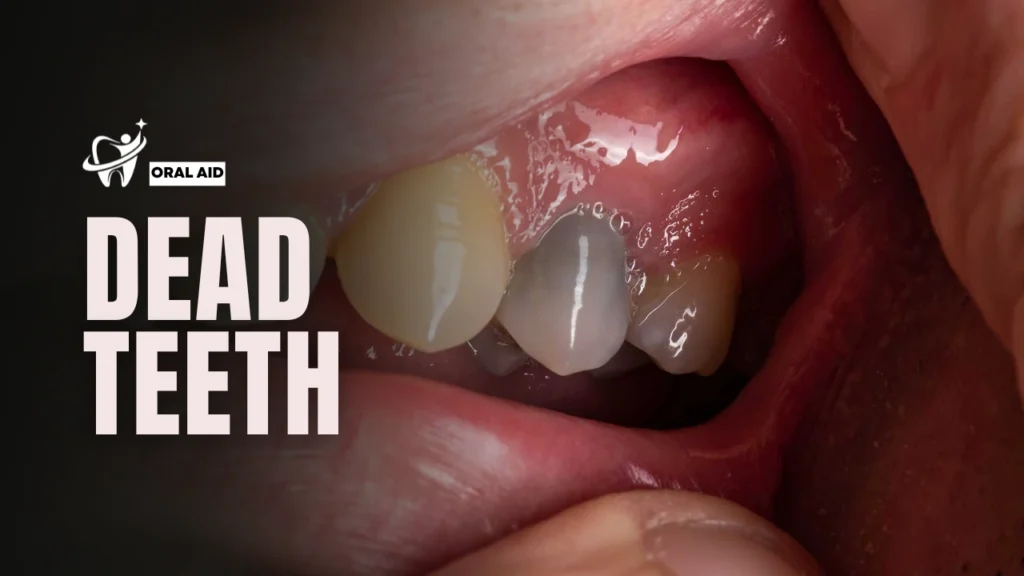
This is often the first visible sign and one of the most telling. A dying tooth may shift from white to yellow, gray, or even black. This discoloration starts inside the tooth, which is why teeth whitening treatments will not correct it. The colour change comes from the breakdown of haemoglobin and red blood cells inside the dying pulp, which stains the dentinal tubules from within.
Pain, or the absence of it
Some people do not feel any pain. Others feel mild pain, and still others will feel intense pain. The pain is often caused by the dying nerve. It can also be caused by infection. The variability makes this symptom both important and misleading. A tooth with a freshly dying nerve can produce sharp, severe pain.
Sensitivity changes
A dying tooth often behaves differently to temperature before going silent entirely. You may notice that a tooth that used to respond normally to hot or cold stops responding. A vital tooth responds with temporary sensitivity when tested, while a dead tooth shows no response. This kind of unexplained numbness in a single tooth is worth raising with your dentist.
Swelling around the gum
If an infection caused the death of your tooth, there is a chance you will also experience swollen tissue surrounding the tooth. This swelling often occurs as the infection spreads from the tooth into the surrounding gum tissue. The gum around the affected tooth may appear red, puffy, or feel tender to the touch. This is not the same as general gum inflammation from poor brushing; it is localised to one specific area.
A pimple or bump on the gum
A pimple at the gum line is a sign of a chronic tooth abscess that has made its way through the bone to the surface of your gums. This small raised bump is called a fistula and is essentially a drainage point for the pus accumulating at the root tip. It is sometimes accompanied by a salty or unpleasant taste in the mouth when it ruptures. Finding a pimple on your gum that keeps returning, even after it bursts, is a clear sign that something significant is happening beneath the surface.
Persistent bad breath or bad taste
A dead tooth sometimes causes bad breath or a bad taste in the mouth. This comes from tooth decay or infection inside the tooth. The bacteria decomposing the pulp tissue produce gases and byproducts that no amount of mouthwash will neutralise, because the source is inside the tooth itself.
A tooth that feels loose or structurally changed
Also, a dead tooth can become loose, chip easily, or fracture as the inner structure weakens. Without living pulp providing moisture and structural support to the dentinal tubules, the tooth becomes more brittle over time. If a tooth feels different when you bite down or has chipped without an obvious cause, this should prompt a visit rather than a wait-and-see approach.
What Happens If You Leave a Dead Tooth Untreated
This is the part that many patients underestimate.
A dead tooth is not simply an aesthetic problem or a matter of isolated discomfort. The bacteria inside a necrotic tooth do not stay inside the tooth. Left untreated, the bacteria from a dead tooth can spread and lead to the loss of additional teeth.
If the pulp becomes infected and dies, it will not get better on its own. Without dental treatment, the infection that killed the pulp can spread to the bone around your tooth, and a pocket of pus can form within your jawbone. This is a dental abscess, and it is a serious infection. In extreme cases, dental abscesses can spread to the jaw, neck, and surrounding structures. In rare and severe cases, the infection from an untreated dead tooth can enter the bloodstream, potentially affecting other body systems and organs, a condition known as sepsis that requires immediate medical intervention.
The practical consequence for most Lagos patients who delay treatment is simpler but still significant: what could have been treated with a root canal becomes an extraction. What could have been restored with a crown becomes a gap that then requires an implant or bridge. Every week of delay compounds the cost and complexity of what eventually needs to be done.
Dead Tooth Treatment Options
The right treatment depends on how much of the tooth’s structure remains intact and whether infection has spread beyond the tooth itself.
First, we look at root canal treatment, the most common treatment for dead teeth. The dentist drills into the top of the tooth, cleans the dead material out of the pulp chamber and root canals, and fills the canals with a rubber-like material to seal against bacteria and future infection. Contrary to what many Lagos patients fear, a root canal on a tooth with a dead nerve is typically far less painful than expected, because the nerve that would generate pain during the procedure is no longer functional.
After a root canal, a crown is typically placed to protect the treated tooth from fracture and restore its function and appearance. Because a dead tooth can become brittle, the crown provides the structural support that the tooth can no longer generate internally. You can read more in-depth about root canal treatment in Lagos.
The second treatment option for a dead tooth is extraction. Extraction is not the first choice because losing a natural tooth creates its own set of problems, including bone loss at the extraction site and neighbouring teeth shifting into the gap over time. But when the damage is too extensive for a root canal to leave a functional tooth behind, extraction followed by a replacement option is the right path.
What You Can Do to Prevent a Dead Tooth
Prevention comes down to two things: hygiene and not avoiding the dentist when something changes.
Brushing twice daily and flossing once daily removes the plaque that leads to the decay that leads to pulp death. This is not complicated advice, but it prevents the majority of cases. Wearing a mouthguard during contact sports, something that relatively few Lagos players do consistently, significantly reduces the risk of trauma-related tooth death.
Schedule at least annual dental visits so your dentist can detect and treat tooth decay early, before the decay reaches your pulp. And if you take a blow to the mouth, see a dentist even if nothing appears to be wrong. The delayed nature of trauma-related tooth death means the window for preventive intervention may only be open briefly.
Do Not Wait for the Pain to Tell You Something Is Wrong
In our experience at Dr. Reach Dental Clinic, the patients who fare best with dead teeth are the ones who came in early, often prompted by something subtle: a colour change they almost dismissed, a gum pimple they thought would go away, a routine check-up that flagged something on X-ray.
The patients who face extractions and bone loss are almost always the ones who waited. If anything in this article sounds familiar, book an appointment at Reach Dental Clinic in Yaba or Ikeja. We will examine the tooth, take X-rays if needed, and give you an honest assessment of what you are dealing with and what your options are.