Skip to content
Most Lagos residents brush twice a day. Far fewer floss regularly, and the reasons are consistent: the string cuts into fingers, it is fiddly to manoeuvre properly, and, honestly, nobody enjoys it.
The consequence of skipping it shows up eventually. Plaque between teeth that a toothbrush never reaches hardens into tartar, which irritates gums, causes bleeding, and over time contributes to the kind of gum disease that is far more difficult and expensive to treat than it was to prevent.
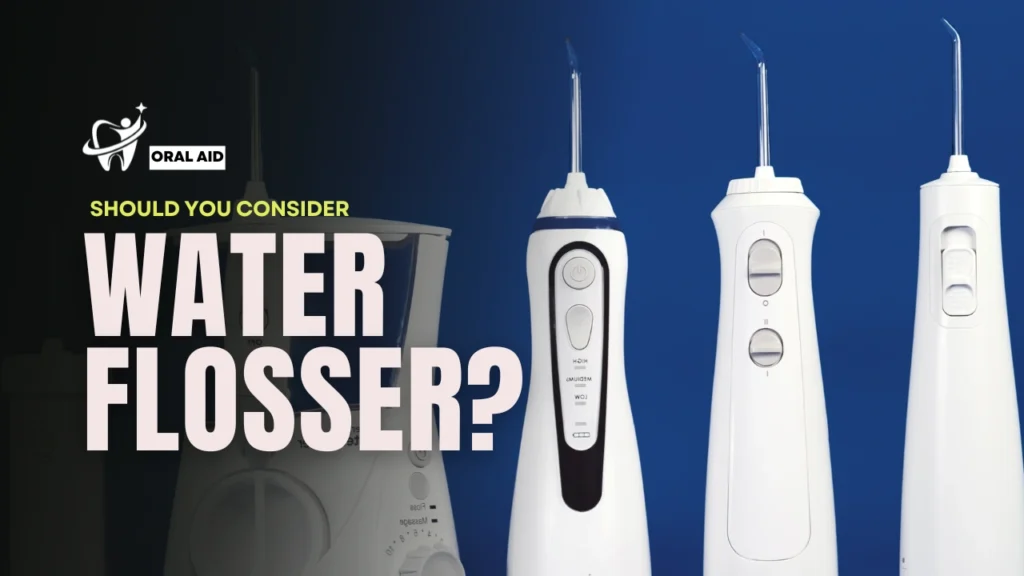
Water flossers have been gaining attention in Lagos as an alternative, and for good reason. They are easier to use, less abrasive on gum tissue, and for certain patients, clinically more effective than string floss. But they are not a universal solution, and whether one is right for you depends on factors worth understanding before spending money.
This article covers what a water flosser actually does, how the evidence compares it to regular floss, who benefits most, and what to expect when buying one in Nigeria.

What Is a Water Flosser?
A water flosser, also known as an oral irrigator, is a handheld device that directs a pressurised stream of water to clean between teeth and along the gum line. You fill a small reservoir with water, place the tip just inside your mouth near the gum line, and guide it along each tooth surface. The pulsating water stream flushes out food debris, disrupts plaque, and irrigates the gum pockets that a toothbrush cannot reach.
It does not scrape or cut. There is no string to thread, no technique that requires a certain level of hand dexterity. You direct the stream, and the water does the work.
Most devices on the market today offer multiple pressure settings, ranging from a gentle mode suitable for sensitive gums to a stronger mode for more thorough cleaning. The water reservoir typically holds between 150ml and 300ml, enough to floss the entire mouth in one fill.
How Does a Water Flosser Compare to Regular Floss?
This is the question most people arrive with, and the honest answer is that both methods work, but they do not work in the same way.
Traditional floss is considered the gold standard by dentists and dental hygienists. It is effective in preventing gingivitis and gum disease if done correctly and regularly. It is also inexpensive, portable, and available anywhere. The limitation is the word “correctly.”
Proper string flossing requires a specific technique, wrapping the floss in a C-shape around each tooth and moving it up and down beneath the gum line, which many people never actually learn. Research consistently shows that even among people who report flossing daily, a significant proportion do not do so in a way that effectively removes plaque.
Water flossers appear likely to remove more plaque, especially in hard-to-reach areas. In adults, both traditional string dental floss and water flossers are effective in removing plaque, but water flossers come out ahead when comparing the two methods directly.
A study in the Journal of Periodontology found that water flossing was more effective at reducing gingival bleeding and inflammation compared to traditional flossing, with water flosser users experiencing a 51% reduction in gingivitis.
What string floss still does better is physically dislodge and remove plaque that has bonded tightly to the tooth surface between teeth. Water pressure disrupts and flushes, but the mechanical scraping action of string floss has no direct equivalent in a water flosser. For patients with healthy gums and no orthodontic hardware, some dentists still prefer to recommend traditional floss and ensure the technique is right before switching to a device.
Who Benefits Most From Using a Water Flosser?
While anyone can benefit, certain patients get noticeably more value from a water flosser than others. People with braces, dental implants, gum disease, and limited hand dexterity can al greatly benefit from using a water flosser.
- People with braces
String floss and braces are a genuinely frustrating combination. Water flossers are ideal for people with braces because they can access areas that string floss may not reach and avoid the hassle of floss getting stuck or tangled in brackets.
- People with dental implants, bridges, or crowns
Dental implants can snag or break string floss. The margins around implants, crowns, and bridges are also areas where plaque tends to accumulate. A water flosser’s stream reaches underneath bridge pontics and around implant posts.
- People with gum disease or a history of it
A Harvard Health Publishing article notes that water flossers may be more effective in reducing gingival bleeding and inflammation, especially in patients with gum disease. The pulsating water stream also massages the gum tissue, stimulating circulation, and can help tighten gums that have begun to pull away from the teeth.
- People with limited hand dexterity
Older patients, those with arthritis, or anyone who finds manual string floss difficult will find a water flosser considerably easier to use.
- People who simply do not floss
If you are part of the majority who own a box of floss but rarely use it, a water flosser removes most of the friction from the habit. It takes about sixty seconds, produces an immediately satisfying result, and does not cause the gum soreness that new string flossers often experience in the first week. Consistency is more valuable than perfection in oral hygiene, and a water flosser used daily beats an excellent string floss technique
How to Use a Water Flosser Correctly
The device is intuitive, but a few points make the difference between using it effectively and just splashing water around.
Fill the reservoir with lukewarm water. Cold water can be uncomfortable on sensitive teeth. Lean over the sink before switching it on, as the stream will produce some spray, especially at higher settings.
Start on the lowest pressure setting if you are new to water flossing. If using a water flosser, start on a low setting and work your way up. Higher pressure is not automatically better and can irritate healthy gum tissue if used before your mouth adapts.
Place the tip at a 90-degree angle to the tooth surface, just at the gum line. Do not aim the stream directly into the gum tissue. Guide the tip along the gum line between each tooth, pausing briefly at each gap to allow the pulsation to flush the area. Work systematically on the inside and outside surfaces of your upper and lower teeth.
Close your lips loosely around the tip to contain the water, then let it drain from the corner of your mouth into the sink. Trying to keep your mouth sealed creates pressure that sends water everywhere.
Use it once daily, ideally after brushing. It does not replace brushing; it supplements it. Some dentists recommend flossing before brushing so that the toothpaste’s fluoride can reach the surfaces between the teeth. Either sequence is acceptable, but consistency matters more than order.
Conclusion
Gum health is one of the most overlooked parts of dental care in Lagos. Most people do not think about their gums until there is a problem, and by that point, what could have been managed with a daily two-minute habit now requires clinic visits, scaling, and sometimes more involved intervention.
A water flosser is not a luxury device. For the right patient, it is one of the most practical tools available for maintaining gum health between clinic visits.
If you are unsure whether a water flosser is right for your specific situation, especially if you have braces, implants, or a history of gum issues, book an appointment at Dr. Reach Dental Clinic in Yaba or Ikeja. We will advise you based on what your mouth actually needs.