Skip to content
Most people in Lagos only think about visiting the dentist when a tooth starts hurting. By that point, the problem has usually been building for months, sometimes longer. The pain you feel is rarely the beginning of a dental issue. It is almost always the end stage of one.
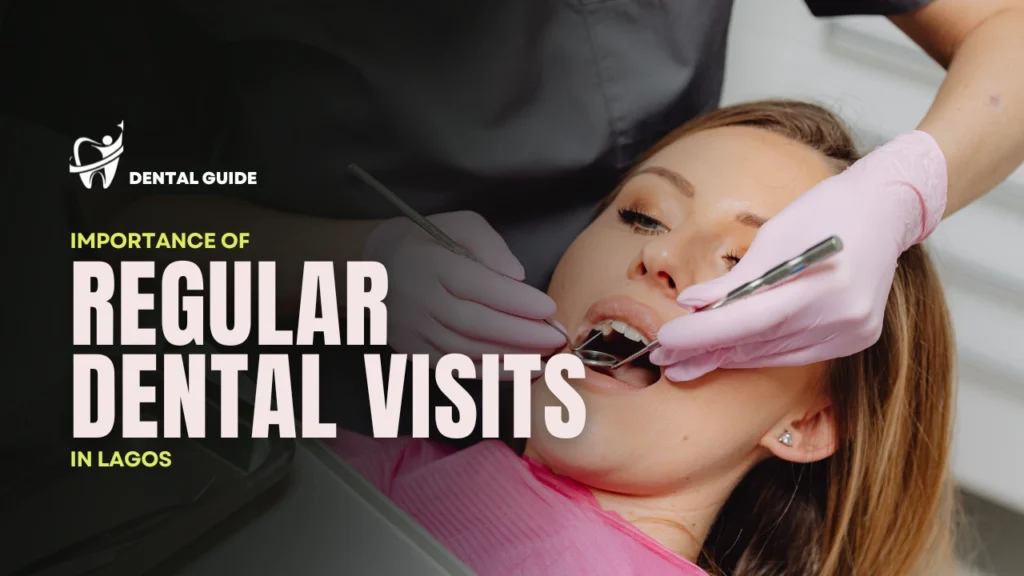
Regular dental checkups are not just about cleaning your teeth. They are about catching problems early, before they become painful, expensive, or complicated. This guide walks you through all you should know about what a proper checkup involves, how often you should go, etc
7 Important Reasons You Must Go for Regular Dental Checkups
Most dental problems do not announce themselves. They develop quietly, and by the time you feel something, the work required to fix it is usually bigger than it needed to be. These are seven concrete reasons why regular dental checkups deserve a permanent spot in your health routine:
- Early detection saves teeth and money
- Tartar cannot be removed at home
- Gum disease is mostly painless until it is serious
- Your dentist checks for more than just your teeth
- Your oral health is connected to your overall health
- Children’s teeth need monitoring from early on
1. Early detection saves teeth and money
The earlier a dental problem is caught, the simpler and less expensive it is to treat. A small area of decay found at a routine visit can be handled with a straightforward filling. The same cavity left unattended for another year may require a root canal or even extraction. A checkup every six months is the most cost-effective dental decision you can make.
2. Tartar cannot be removed at home
Even with consistent brushing and flossing, plaque hardens into tartar in areas your toothbrush cannot fully reach. Once tartar forms, only a professional cleaning will remove it. Without that, tartar accumulates along the gum line, triggers inflammation, and eventually leads to gum disease. A routine checkup includes the scaling and polishing that keeps this cycle from starting.
3. Gum disease is mostly painless until it is serious
Bleeding gums when you brush are one of the earliest signs of gum disease. Left untreated, gingivitis progresses to periodontitis, a condition that damages the bone supporting your teeth. Bone loss from periodontitis is largely irreversible. Catching gum disease early, during a routine visit, is when it is still completely manageable.
4. Your dentist checks for more than just your teeth
A thorough dental examination includes examining your tongue, throat, cheeks, and the soft tissues inside your mouth. Dentists are trained to spot early signs of oral cancer, which is more common in Nigeria than many people realise and significantly more treatable when caught early. This screening alone is a reason to keep your appointments.
5. Your oral health is connected to your overall health
Research has consistently linked poor oral health to systemic conditions, including heart disease, diabetes complications, and respiratory infections. People living with diabetes in Lagos are at a particularly higher risk of gum disease, and gum disease in turn makes blood sugar harder to control.
6. Children’s teeth need monitoring from early on
For parents, dental checkups are how small problems in your child’s teeth and jaw development are caught before they become orthodontic issues that require braces or extractions later.
How Long Does a Dental Checkup Take?
A routine checkup with cleaning typically takes between 30 and 60 minutes. If you have significant tartar buildup, require X-rays, or have not visited in several years, it may take a bit longer. Many people working in Ikeja, Victoria Island, or Lagos Island find that scheduling an early morning or Saturday appointment fits most comfortably into a Lagos workday without disrupting productivity.
How Often Should You Get a Dental Checkup in Nigeria?
Twice a year, roughly every six months, is the widely accepted guideline for most healthy adults and children. This frequency allows your dentist enough time to catch problems at an early, manageable stage, before they require more complex or costly treatment.
That said, this is a baseline, not a fixed rule for everyone.
Why Lagos Residents Tend to Skip Dental Visits
“My Teeth Don’t Hurt” Is Not the Same as “My Teeth Are Fine”. This is the most common reason people in Nigeria delay dental care, and it is also the most costly assumption to make.
Tooth decay begins as demineralisation of the enamel, a process that causes zero pain. By the time decay has worked through the enamel and into the softer dentine layer, it is visible on an X-ray but still unlikely to cause significant discomfort. Pain typically only starts when the decay is deep enough to affect the nerve, which is when treatment becomes significantly more involved.
The same pattern applies to gum disease. The early stage, called gingivitis, is often completely painless. Bleeding gums when brushing is the most common signal, but many people dismiss this as normal. If gingivitis progresses to periodontitis, it can cause bone loss around the teeth, and that damage is largely irreversible.
| The Real Cost of Waiting A routine dental checkup with cleaning in Lagos costs a fraction of what you will pay for a root canal, dental crown, or tooth extraction. Catching decay at the early stage might mean a simple filling. Catching it at the late stage almost always means a more complex, more expensive procedure, and more time in the dental chair. |
What a Dental Checkup Actually Involves in Lagos
Many people avoid dental visits because they are not sure what to expect. Here is a straightforward walkthrough of what a standard dental checkup looks like at a professional clinic in Lagos.
1. Review of Your Dental and Medical History
If this is your first visit or you have not been in a while, your dentist will ask about your general health, any medications you are taking, and any concerns you currently have. Some health conditions, such as diabetes and heart disease, have direct connections to oral health.
2. Visual Examination
Your dentist will examine every tooth, your gums, your tongue, the roof of your mouth, and your throat. They are looking for early signs of decay, gum disease, unusual tissue changes, and sometimes early indicators of oral cancer, which is more common than most people realize.
3. Dental X-rays (When Needed)
X-rays allow your dentist to see what cannot be seen with the naked eye: decay between teeth, bone loss beneath the gum line, impacted teeth, or infections developing at the root. Not every visit requires X-rays, but they are an important diagnostic tool that helps avoid missed diagnoses.
4. Scaling and Polishing
This is the professional tartar removal process. Your dentist or hygienist uses ultrasonic and hand instruments to break down and remove tartar deposits, particularly those along the gum line. After scaling, your teeth are polished to remove surface stains and leave a smooth finish that makes it harder for plaque to adhere quickly.
5. Personalised Advice
Before you leave, your dentist will review their findings and give you specific guidance based on your oral condition. This might include recommendations on brushing technique, dietary habits, or a treatment plan if any issues were found.
Regular Dental Checkups for Children in Lagos
The recommended guideline from paediatric dental associations is that a child’s first dental visit should happen by their first birthday, or within six months of their first tooth coming through, whichever comes first.
This might feel very early, and many Lagos parents are surprised by this recommendation. But the purpose of an early visit is not to perform any drilling or complex treatment. It is to examine the early teeth and jaw development, and to give parents guidance on how to care for baby teeth properly. It can also help your child become comfortable in a dental environment.
Establishing this habit early makes a significant difference. Children who visit the dentist regularly from a young age are far less likely to develop dental anxiety and are more likely to maintain good oral hygiene habits into adulthood.